
中文
-
About ANSO
-
News & Media
-
Members
-
Events
-
Programs
-
Publications
-
Get Involved
On 31 March 2026, the workshop on “Strategies of Climate Change Mitigation and Sustainable Development” was successfully held at the National Research Centre (NRC) in Cairo, Egypt. The event was organized under the CAS-ANSO Co-funding Research Project “Innovation in climate-resilient agro-food security based on satellite interpretation, inverse accounting and mitigation strategies of air pollutions and greenhouse gases emissions” (CAS-ANSO-CFRP-2024-04). The workshop brought together nearly 100 experts and scholars from China and Egypt to discuss cutting-edge technologies for climate mitigation, joint monitoring networks, and cross-regional emission reduction strategies.
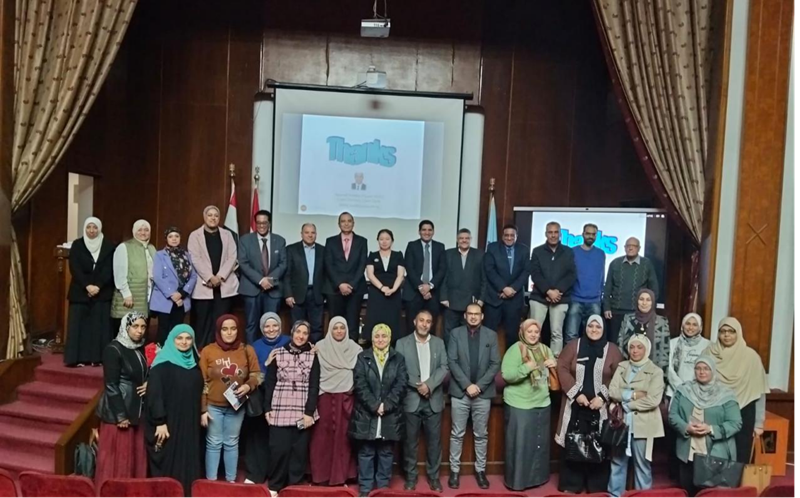
The opening ceremony was co-chaired by Prof. Dr. Ahmed Youssef, Dean of the Chemical Industries Research Institute, NRC; Prof. Dr. Ayman Rashad, Head of the Photochemistry Department, NRC; and Prof. Dr. Yasser Mahmoud Ali, Workshop Chair and Egypt Lead of the ANSO project. In his opening remarks, Prof. Yasser Mahmoud Ali emphasized that with strong support from ANSO, Egyptian and Chinese scientists have achieved substantial progress in greenhouse gas satellite interpretation, emission inversion accounting, and the development of climate-resilient agricultural and food systems. He noted that this collaboration has not only deepened bilateral scientific exchange but has also injected new scientific momentum into climate action across Africa and the Middle East. Following the opening, Prof. Ahmed Youssef and Prof. Ayman Rashad delivered speeches on Egypt’s green transition pathway under Egypt Vision 2030 and innovative applications of photochemical technologies in environmental monitoring, respectively, systematically outlining Egypt’s science and technology needs for green development and the potential for enhanced Egypt-China cooperation.
During the main keynote session, leading experts from Chinese and Egyptian institutions presented their latest research findings on greenhouse gas emission reduction, advanced monitoring technologies, and novel pollution control materials, drawing wide attention and lively discussion. Prof. Yasser Mahmoud Ali delivered a keynote titled “Strategies for Reducing Greenhouse Gas Mitigation and Sustainable Development,” in which he introduced the latest progress of the ANSO project in satellite interpretation and inversion accounting of atmospheric pollutants and greenhouse gases, demonstrating practical pathways for coordinated carbon and pollution reduction in Egypt and China. Assoc. Prof. Dr. HAN Yinghui from the University of Chinese Academy of Sciences, China, Project Lead, presented a report on “The Spatio-Temporal Emission Characteristics of the Long-Lived Greenhouse Gas N₂O and Sustainable Reduction Strategies.” Using satellite remote sensing inversion, she systematically analyzed the emission source composition and reduction pathways of nitrous oxide in both countries, offering insights that are both regionally targeted and globally relevant. Prof. Dr. Walid Tawfik from the Faculty of Science, Cairo University, spoke on “Advanced Laser Technology Applications in Environmental Monitoring: A Strategy for Climate Change Mitigation,” showcasing breakthroughs in high-precision laser spectroscopy for real-time pollutant tracking and online greenhouse gas monitoring, and proposing a joint Egypt-China “Nile-Yangtze River Basin Laser Monitoring Demonstration Network,” which received enthusiastic feedback. Prof. Dr. Elham Farouk from the Environmental and Climate Change Research Institute, National Research Centre, Egypt, delivered a report on “Nanotechnology: The Future of Environmental Air Pollution Control,” systematically elaborating from the molecular design of novel nano-materials to engineering case studies on industrial waste gas purification, highlighting both the potential and challenges of nanotechnology in air pollution control.
A dedicated panel discussion was held under the theme “Roadmap for Climate Change Mitigation for Improving Air Quality and Its Relation to Environment, Health, Economy, and Sustainable Development.” Experts engaged in in-depth dialogue on key issues, including feedback mechanisms between environment and climate, cross-sectoral impacts of CO₂ emissions, green transformation under Egypt Vision 2030, China’s practical experience in tackling N₂O emissions, and local “Waste-to-Energy” projects in Egypt. During the discussion, participants reached substantial consensus on future joint research plans, development of multi-source data sharing platforms, joint training of early-career scientists, and applications for spin-off collaborative projects.
On 1–2 April, the project team organized visits to advanced laboratories at NRC and held internal closed-door discussions on the next-phase technical roadmap, data sharing mechanisms, and expansion of the Global South cooperation network, further consolidating consensus and clarifying follow-up actions.
Through this workshop and the continued implementation of the project, Egypt and China have built a high-level cooperation network for coordinated carbon and pollution reduction and climate mitigation strategies, oriented toward the Belt and Road region and the Global South. Looking ahead, the project team will, under the ANSO international cooperation framework, further invite national institutions from Africa, Southeast Asia, Latin America, and other Global South regions to join the network. This will enable cross-regional open sharing of monitoring technologies, mitigation solutions, and talent training, providing replicable and scalable innovations to address the global climate challenge. The project contributes directly to key UN SDGs, including SDG 13 (Climate Action), SDG 2 (Zero Hunger), and SDG 11 (Sustainable Cities and Communities).









 No.16 Lincui Road, Chaoyang District, Beijing, China
 86-10-84097121
 anso-public@anso.org.cn