
中文
-
About ANSO
-
News & Media
-
Members
-
Events
-
Programs
-
Publications
-
Get Involved
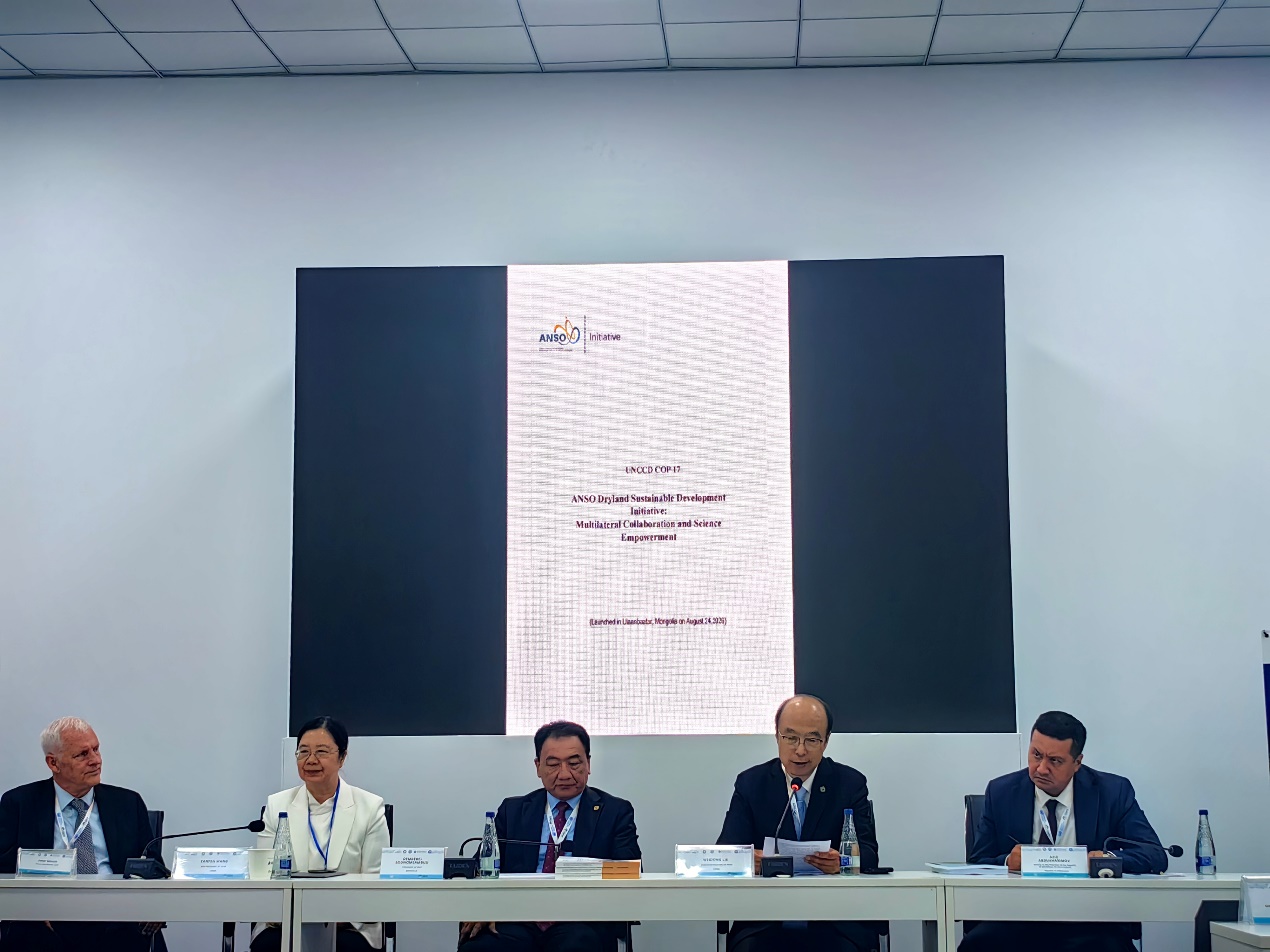
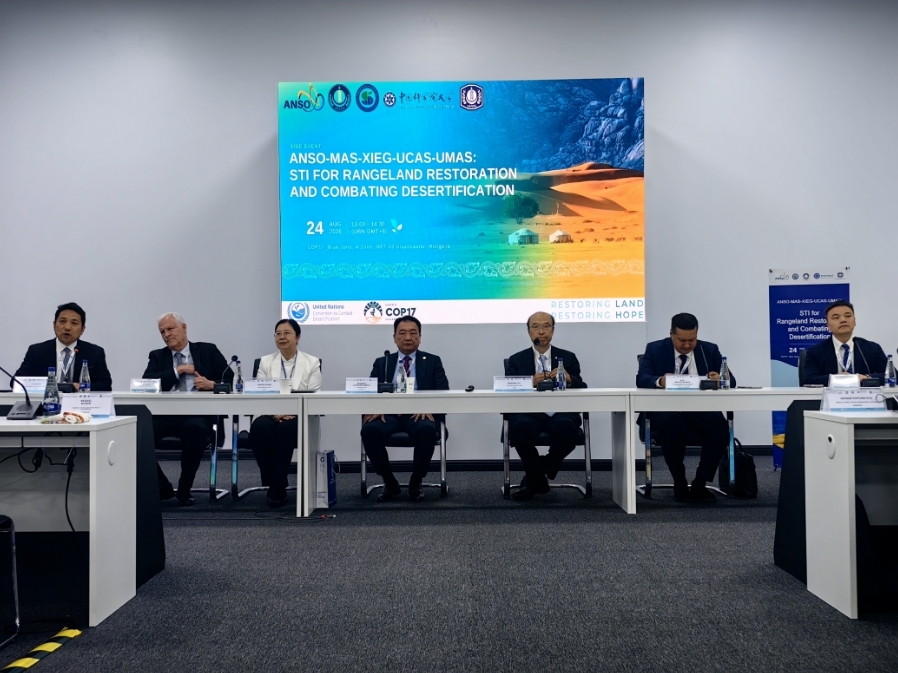
On August 24th, in the witness of all participants attending the ANSO Side Event at UNCCD COP 17, ANSO released two science reports, namely, Unlocking Opportunities for Combating Desertification and Advancing Sustainable Dryland Governance; Eurasian Grassland Change and Sustainable Development. Dr. Barron Joseph Orr from the UNCCD Secretariat extended warm congratulations on the release of the two reports in his closing remarks at the side event. He himself also contributed to drafting the first‑mentioned science report. Prof. LIU Weidong, Executive Director of ANSO, presented the two newly‑released ANSO Science Reports to Dr. Barron on‑site.
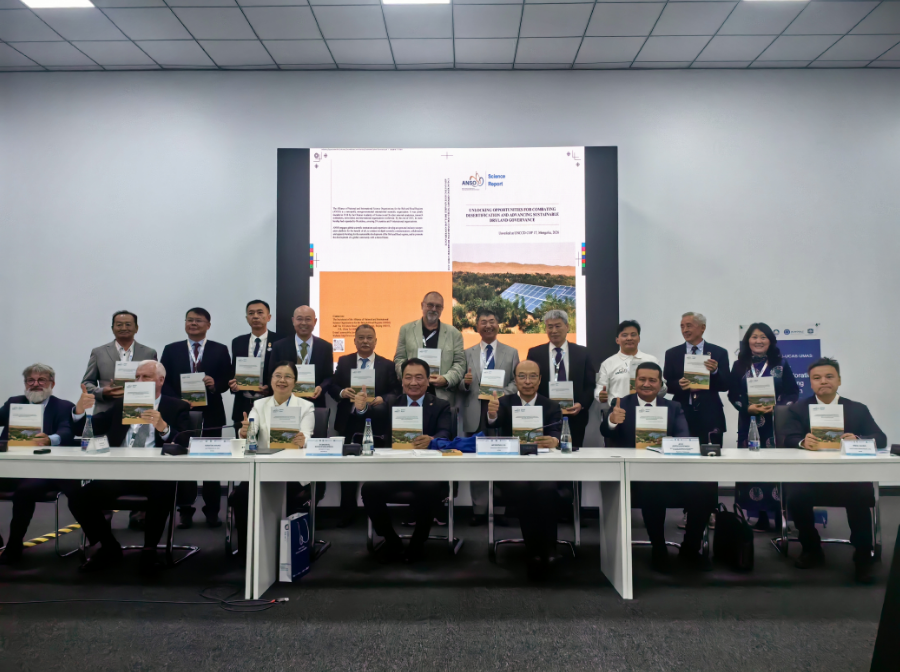
This report, Unlocking Opportunities for Combating Desertification and Advancing Sustainable Dryland Governance, was developed by ANSO in collaboration with, and with technical support from the Xinjiang Institute of Ecology and Geography (XIEG), Chinese Academy of Sciences (CAS). Both jointly invited a wide range of experts to compile the report, which includes case studies of governance practices from numerous typical regions across the globe. This report has provided scientific and technical support for relevant thematic discussions at COP17 and underpinned the ANSO Dryland Sustainable Development Initiative: Multilateral Collaboration and Science Empowerment. The report’s Editors-in-Chief Prof. Lei Jiaqiang and Prof. Peter Gilruth pointed out that one of the most pressing core issues in current desertification governance is to achieve close linkage among science‑research, policy‑making and management. The report stresses that governance outcomes should not be measured merely by the area of restored land, but assessed against long‑term regional ecological governance capacity, inter‑sectoral coordination mechanisms and ecological resilience.
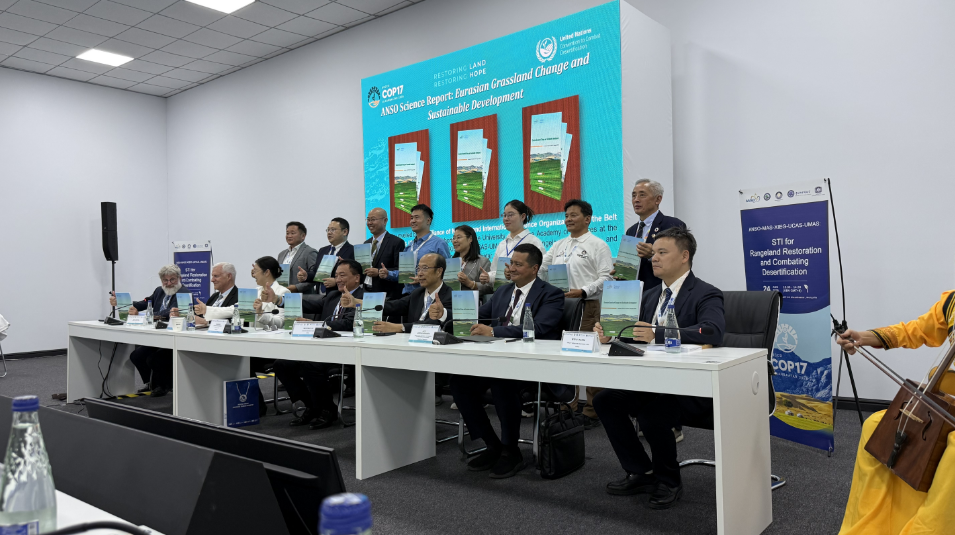
Eurasian Grassland Change and Sustainable Development was also developed by ANSO, in collaboration with, and with technical support from the University of Chinese Academy of Sciences (UCAS). The jointly invited experts compiled this report as the world’s largest contiguous grassland, the Eurasian Grassland faces multiple degradation threats including climate variability, over‑grazing and excessive groundwater extraction. The Eurasian Grassland exhibits a spatially‑differentiated pattern of “degradation in the west and revegetation in the east” together with a trend of shrub encroachment. This report shares the latest scientific assessment findings and summarizes replicable collaborative restoration models such as the grazing‑photovoltaic complementary rotational grazing practice in Qumarlêb, China, and native shrub restoration in Kazakhstan. It provides critical scientific evidence for regional adaptive management. This report has also provided scientific and technical support for relevant thematic discussions at COP17 and underpinned the ANSO Dryland Sustainable Development Initiative: Multilateral Collaboration and Science Empowerment. Prof. Wang Yanfen, Member of CAS and the invited Editor-in-Chief of the report, called for establishing a cross‑border partnership for sustainable Eurasian grassland management. She proposed integrating grassland health into nationally determined contributions (NDCs) and carbon‑market mechanisms, and building an integrated space‑air‑ground grassland monitoring and early‑warning platform.







 No.16 Lincui Road, Chaoyang District, Beijing, China
 86-10-84097121
 anso-public@anso.org.cn