
中文
-
About ANSO
-
News & Media
-
Members
-
Events
-
Programs
-
Publications
-
Get Involved
From April 20 to 24, 2026, the 29th annual session of the United Nations Commission on Science and Technology for Development (UNCSTD) was held in Geneva. Professor WU Bingfang from the Aerospace Information Research Institute of the Chinese Academy of Sciences (AIRCAS) was invited to attend and deliver a plenary report. During the session on “Technical cooperation activities in the field of science, technology and innovation (STI)”, he highlighted the progress and outcomes of the CropWatch Innovative Cooperation Programme for Agricultural Monitoring (CropWatch-ICP), an initiative launched by the Alliance of International Science Organizations (ANSO). This initiative aims to promote and strengthen crop monitoring efforts in developing countries, thereby supporting the realization of the Zero Hunger target under the United Nations Sustainable Development Goals.
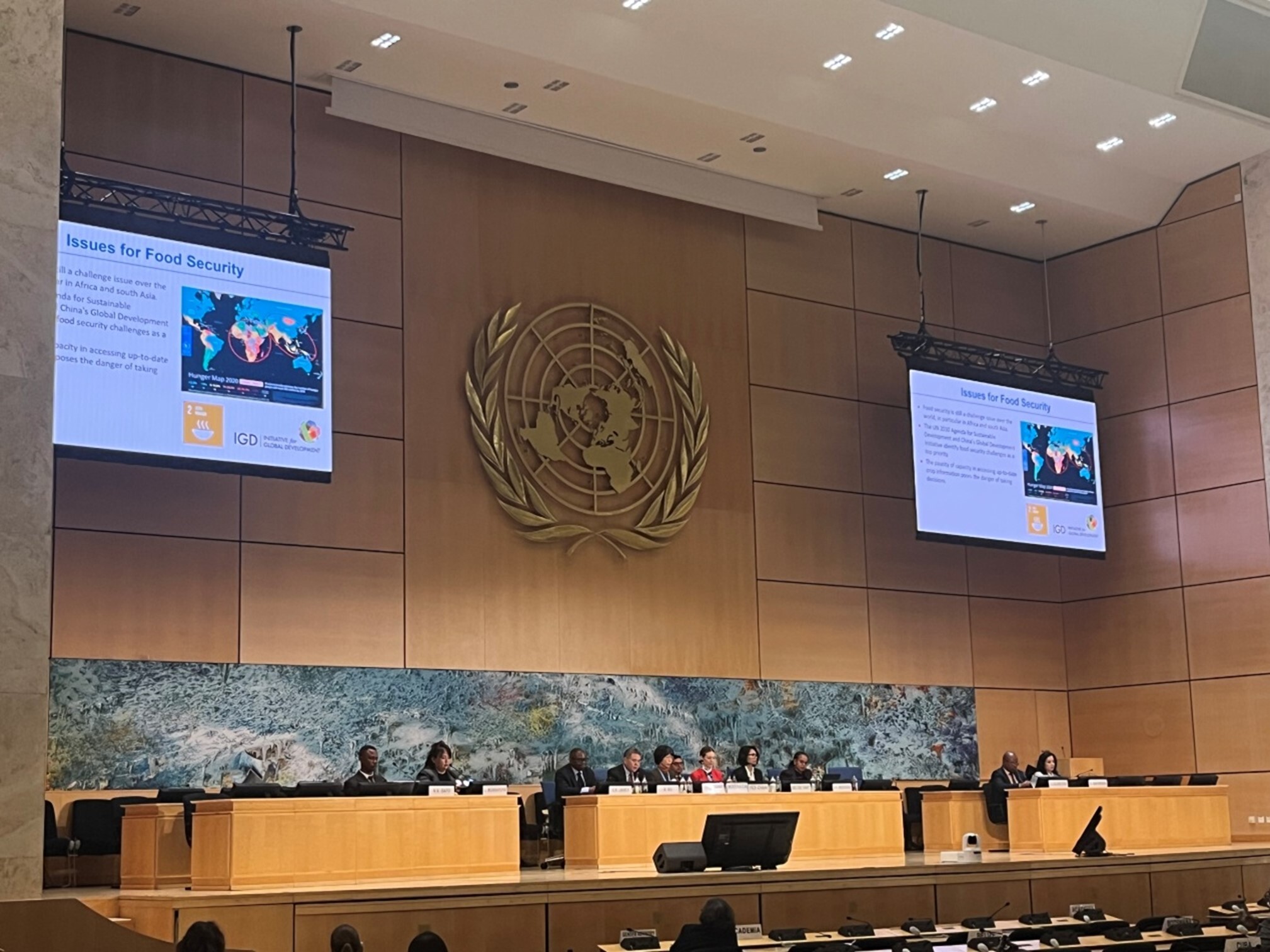
Food security is a global challenge, particularly in Africa and South Asia, where many countries lack access to timely and accurate crop information, hindering policy-making and agricultural production management. To address this issue, at the 23rd annual session of UNCSTD, ANSO, in collaboration with UNCSTD, launched the CropWatch-ICP initiative. The initiative aims to enhance the autonomous crop monitoring capabilities of developing countries primarily by providing free and permanent access to the CropWatch system, along with comprehensive training and capacity building. Currently, to meet the demands of developing countries, the CropWatch system is deployed on the Alibaba Cloud platform. It offers 15 baseline data layers (including crop planting area, irrigation map, and terrace map) and over 50 monitoring indicators. Integrated with AI technology, the system has introduced "CropWatch GPT"—a large language model-based intelligent agent for crop monitoring that can automatically generate country reports, significantly lowering the barriers to crop monitoring data analysis. Through free and open technical services, CropWatch-ICP helps reduce the technical and financial obstacles faced by developing countries in the field of food monitoring. To date, CropWatch-ICP has carried out capacity building in 32 countries, organizing five regional workshops, 11 national training sessions, 13 specialized training courses on ground survey methods, and six hands-on operational trainings. More than 600 technical personnel from 46 institutions have been trained. The system has been locally deployed in seven countries, including Nigeria, Mozambique, and Mongolia. Furthermore, a regional center for West Africa has been established to provide technical support for West African countries in utilizing CropWatch through localized services and to conduct joint research on issues of common concern.
During this session, representatives from Nigeria, Zimbabwe, and other countries shared their experiences and achievements in participating in the CropWatch-ICP. They stated that the initiative has effectively enhanced the accuracy of their national crop monitoring systems and improved their emergency response capabilities, making it a vital tool for achieving the SDG Goal of Zero Hunger. Mr. Godstime Kadiri James, Director of the Strategic Space Applications Department at the National Space Research and Development Agency (NASRDA) of Nigeria, noted that using the CropWatch platform—after localized validation—his agency now produces and distributes crop monitoring reports every two months to agricultural practitioners. He expressed gratitude to the Chinese CropWatch team and emphasized, “If you want to go far, go with others.” He firmly believes that through partnerships, the CropWatch-ICP solution will continue to advance across Africa. The representative from Zimbabwe stated that after joining CropWatch-ICP in 2023, they have organized workshops, participated in regional seminars, and learned relevant crop monitoring technologies, including the use of cloud platforms and analytical tools. This support came at a very timely moment, as it meets local needs and further promotes the peaceful application of space science for socio-economic development.
This annual session of UNCTAD focused on the role of science, technology, and innovation (STI) in the era of artificial intelligence. The successful practice of CropWatch provides the Global South with a replicable and scalable example of technical cooperation.








 No.16 Lincui Road, Chaoyang District, Beijing, China
 86-10-84097121
 anso-public@anso.org.cn